
Is AI Music Copyrighted? Can You Sell It or Use It on YouTube? (2026)
The US Copyright Office already answered the copyright question, and the answer is nobody owns a purely AI-generated song. What you really have is a license from the platform, so here is what four of them actually let you do with your music.

The only license here you can read in full before paying, and the only one you can buy once and keep after you stop paying.
Best for A license you can read in full before paying
Visit CreateYourMusicThe cheapest monthly route to commercial rights, tied to a subscription that has to stay alive.
Best for The cheapest monthly commercial plan
The strongest "you own it" wording for paid output, inside terms a contract can actually grant.
Best for The strongest ownership wording for paid output
Commercial terms unpublished, exports disabled. The rights question is currently academic here.
Is AI music copyrighted? Under current US law, no. A track generated entirely by an AI model has no copyright at all, because copyright requires human authorship, and the US Copyright Office put that in writing in its January 2025 report on copyrightability: prompts alone do not make you the author, and the purely machine-made parts of a work are not protectable no matter which tool made them or how much you paid it. That single fact reorganizes every other question people ask about AI music, because if nobody holds a copyright, then "do I own my song" and "can I sell it" are not copyright questions. They are contract questions, and the contract is the license your AI music platform granted you.
Which means the practical answer to "is AI music copyrighted" lives in four different Terms of Service, and they disagree with each other more than you would guess. We compared what Suno, Udio, Mureka, and CreateYourMusic actually grant: who allows commercial use and on which plans, whose terms let you monetize a YouTube video, what happens to your rights when the subscription lapses, and which of those grants you can read in full before handing over a card. One of the four tools is ours. We are not going to pretend otherwise, and every claim about the other three carries a source you can check, read directly from official pricing pages, help centers, and Terms of Service.
Short version if you are in a hurry: under current US law nobody can sell you a copyright on a purely AI-generated track, and anyone implying otherwise is oversimplifying. What you can get is a clear, durable license. Suno sells the cheapest monthly one, Mureka has the strongest ownership wording for paid users, Udio currently is not in this conversation because nothing leaves its platform, and ours is the only one here that is published in full, survives cancellation on a Pay Once pack, and was written specifically for the thing most people actually do with AI music: put it inside a video. The rest of this article is the evidence.
AI music license terms at a glance: Suno vs Udio vs Mureka vs CreateYourMusic
| Copyright on the generated track | None, and we say so: US law grants no copyright on purely AI output | None (same law applies) | None (same law applies) | None (same law applies) |
|---|---|---|---|---|
| What the terms grant instead | Published commercial license, worldwide and perpetual on annual and Pay Once | Commercial use rights for new songs on paid plans | ToS assigns paid users ownership, title, and interest in output | Post-partnership terms not published in verifiable form |
| Free-tier rights | Personal listening only, playback without download | Personal, non-commercial, cannot be monetized, not retroactively upgradeable | Output stays Mureka's, non-commercial, attribution required | In-app listening only, nothing exports |
| Cheapest route to commercial use | $99 Pay Once pack, or any annual plan | Pro at $8/mo while the subscription lasts | Paid tiers per its ToS | Not available in verifiable form |
| Monetized YouTube video | Yes on annual and Pay Once; license written for music inside a larger work | Yes on paid plans; free songs cannot be monetized | Yes for paid output per its ownership terms | No file to upload |
| Rights after you stop paying | Pay Once rights have no subscription to lapse; annual license is perpetual for downloaded tracks | New-song rights end with the subscription | Ownership wording attaches to output made while paid | Academic while nothing exports |
| Full license text published | Yes, the complete Music License Agreement | Summarized across help center articles | Yes, in its Terms of Service PDF | Not in verifiable form |
AI music commercial rights by the numbers
Cheapest published route to commercial use rights, held for 24 months. The CreateYourMusic figure is the $99 Lite Pay Once pack, bought once with nothing to renew. Suno Pro is $8 a month and stops granting rights to new songs the month you stop paying. Mureka ties rights to its paid tiers and Udio has not published verifiable post-partnership commercial terms, so both render as ghosts rather than zeros.
Want to make your own? Try the AI Music Generator, AI Music Video Maker, Suno vs Udio, Suno vs Mureka vs CreateYourMusic or Best Free AI Music Generators.
Who owns the songs you make with AI?
Best here: MurekaStart with what no Terms of Service can change. The US Copyright Office's Part 2 report, published in January 2025, is the controlling guidance here, and it is blunt: copyright protects human authorship, purely AI-generated material is not copyrightable, and typing a prompt, however detailed, does not make you the author of what comes back. The DC Circuit's Thaler decision in March 2025 upheld the same principle at the level of law: a work needs a human author to be copyrighted at all. So when someone asks "can AI music be copyrighted", the precise answer is: the AI-generated part, no; the parts you authored, yes, and only those.
That is why every "who owns it" promise in this category needs translating. A platform cannot assign you a copyright that does not exist. What it can do is two real things: promise not to assert its own claims against you, and grant you a contractual license defining what you may do with the output. Those contract rights are genuinely valuable, they are enforceable between you and the platform, and they are what you are actually buying. They are just not a copyright, and the difference matters the day someone else uses a track that sounds like yours, because a contract with your generator binds your generator, not the rest of the world.
Read through that lens, the four tools split cleanly. Mureka goes furthest on paper: its Terms of Service say paid users hold the ownership, title, and interest in what they generate, which is the strongest wording any of the four publishes, and it wins this round for that reason. Free-tier output stays Mureka's, is non-commercial, and requires attribution. Suno does not use ownership language that strong; its help center frames the grant as commercial use rights for new songs on paid plans, with free songs personal and non-commercial permanently. Udio's post-partnership terms are not published in verifiable form, so there is nothing to evaluate. Ours does not use ownership wording either, deliberately: we grant a worldwide, perpetual commercial license on annual plans and Pay Once packs, published in full, because a license we can actually stand behind seemed more honest than ownership language the law cannot back for anyone.
One more consequence of the no-copyright baseline that almost nobody flags: a purely AI-generated track is effectively unprotectable by you against third parties. If a stranger reuses it, your remedies are thin, because you hold no copyright to infringe. That cuts against every tool equally, ours included, and it is a real reason to add your own human authorship (your lyrics, your edits, your arrangement) to anything you care about. The section on registering AI music below covers exactly what that buys you.
CreateYourMusic
Strengths
- The full Music License Agreement is published on our site, readable before you pay
- The grant is worldwide and perpetual on every annual plan and every Pay Once pack
- We state the no-copyright baseline plainly instead of implying ownership the law cannot back
Watch-outs
- We grant a license, not the ownership-style wording Mureka's terms use
- Free-tier tracks are for personal listening only and do not download
Suno
Strengths
- The free-versus-paid rights split is stated plainly in its help center
- Commercial use rights for new songs on Pro and Premier
Watch-outs
- Free-plan songs are personal and non-commercial permanently, and upgrading does not retroactively fix them
- No ownership-style wording; rights attach to an active subscription
Mureka
Strengths
- Its ToS assigns paid users the ownership, title, and interest in generated output, the strongest wording here
- API-generated content carries full commercial rights
Watch-outs
- Free-tier output stays Mureka's, is non-commercial, and requires attribution
- Ownership wording is still a contract grant; it cannot create a copyright US law says does not exist
Udio
Strengths
- Nothing verifiable to evaluate, which is itself worth knowing before you pay
Watch-outs
- Post-partnership commercial and ownership terms are not published in verifiable form
- With downloads disabled at every tier, ownership of an unexportable track is academic
Commercial use: can you sell music made with Suno, Udio, or Mureka?
Best here: CreateYourMusicYes, with the right plan, and the plan is everything. This is the part almost nobody reads until after they have made fifty songs, so here it is before you make the fifty-first: on every tool in this comparison, free songs carry the tightest strings, and the strings do not come off retroactively.
Suno commercial use works like this, per its own help center: songs made on the free Basic plan are intended for personal, non-commercial use, cannot be monetized, and subscribing later does not retroactively grant monetization rights to tracks you made while free. On Pro at $8 a month or Premier at $24, you get commercial use rights for new songs made on the plan. That makes Suno the cheapest monthly route to commercial rights in this comparison, and that stays in its column undiluted. The structural catch is the word monthly: the rights attach to songs made while subscribed, and the arithmetic never stops. $8 becomes $96 in a year and $192 across two, and there is no point at which you have finished paying for the ability to sell your own back catalogue of new work.
Mureka ties commercial rights to its paid tiers, with the ownership wording covered in the previous section doing the heavy lifting: paid output is yours per the ToS, free output is Mureka's, non-commercial, and attribution-bound. Udio, again, has not published verifiable post-partnership commercial terms, and while downloads stay disabled at every tier there is no file to sell anyway. We are not going to guess at terms a company has not stated.
Ours takes this round, and here is the case made carefully, because the win is on a specific axis. The commercial license comes with every annual plan and every Pay Once pack. The Pay Once route is the one nobody else offers at any price: $99 once, and the license on everything you generate with those credits has no subscription attached, which means there is no future month where your rights depend on a card not expiring. And the entire agreement is published as one document you can read before paying, not assembled from help-center fragments. The honest boundary, stated as clearly as we can make it: monthly plans do not include commercial rights, only annual plans and Pay Once packs do, and the license covers your track inside a larger work (a video, an ad, a game, a podcast, client work) rather than release as standalone music on Spotify or other streaming platforms. If your plan is to be a streaming artist, our license says no in writing, and Suno on a paid plan is the honest recommendation for that specific goal.
If you know you will hold a subscription forever and you want the lowest monthly number, Suno's $8 is the better arithmetic and we just said so. We priced for the other pattern, the one we think describes most working creators: a burst of production, a gap, and a client asking for the file again eighteen months later. On a Pay Once pack, month eighteen looks exactly like month one.
CreateYourMusic
Strengths
- Commercial license on every annual plan and every Pay Once pack
- A $99 one-time purchase carries commercial rights with no subscription to keep alive
- The full license text is one published document, not help-center fragments
- The license is written for the most common real use: your music inside a video, ad, game, or client project
Watch-outs
- Monthly plans include no commercial rights; the license comes with annual plans and Pay Once packs
- No standalone streaming releases: Spotify and Apple Music are outside the license, in writing
Suno
Strengths
- Pro at $8 a month is the cheapest monthly route to commercial rights in this comparison
- The rights split is documented plainly in its own help center
Watch-outs
- Free-plan songs can never be monetized, even after upgrading
- Rights attach only to songs made while the subscription is active, and the cost never stops
Mureka
Strengths
- Paid output is owned by the user per its ToS, with full commercial rights on API content
- Stems and MIDI export on paid tiers suit producer workflows where the track gets sold as part of client work
Watch-outs
- Free output is Mureka's, non-commercial, and needs attribution
- Rights sit inside a ToS PDF rather than a standalone license page
Udio
Strengths
- Nothing verifiable to report, which saves you the reading time
Watch-outs
- Commercial terms after the UMG partnership are not published in verifiable form
- Downloads are disabled at every tier, so there is no file to use commercially
Can AI generated music be monetized on YouTube?
Best here: CreateYourMusicYes, AI generated music can be monetized on YouTube, and the two-part test is simpler than the forum threads make it look. Part one is YouTube's side: your channel has to meet the YouTube Partner Program's monetization policies, which require original, authentic content. Using AI music inside a video you made (a vlog, a tutorial, a game video, an ad, a podcast episode) is normal and fine. Where channels get demonetized is mass-produced sameness: YouTube's monetization policies target repetitious, inauthentic content, so a channel that is nothing but bulk-uploaded AI tracks with a static image is the risk case, not a creator scoring their own videos. Part two is the platform's side: you need the license from your AI music tool to actually cover commercial use, because monetized video is commercial use.
Run the four tools through part two. Suno: yes on Pro or Premier for songs made while subscribed, and explicitly no on the free plan; its help center says free songs cannot be monetized, and that includes your YouTube video. Mureka: yes for paid output under its ownership terms. Udio: there is no file to put in your video, so the question does not survive contact with the export button. Ours: yes on every annual plan and every Pay Once pack, and this is the use case our license was literally drafted around, music inside a larger work, which is precisely what a monetized YouTube video is.
The Content ID worry deserves a straight answer too, because "will AI music get me a copyright claim" is half the reason people search this. Content ID works by matching your video's audio against a database of reference files registered by rights holders. A track freshly generated for you is not in that database, so it does not trigger a match by existing there. The realistic risks are narrower: a generation that closely resembles a registered work, or a third party who registers AI tracks with a distributor and causes false claims. You cannot reduce either risk to zero with any tool, ours included, and a tool that promises "no copyright claims ever" is overpromising. What you can do is keep the receipts: your generation history and your license are exactly what YouTube's dispute process asks for, and disputes over genuinely original AI tracks are winnable.
Why we take this round rather than calling it a four-way tie on "buy the right plan": two reasons that compound. First, specificity of the grant: when you monetize a video, the thing you need on paper is the right to synchronize the music inside audiovisual content, and our published license is written in exactly those terms rather than as a general commercial-use nod. Second, the video itself: every paid plan and every Pay Once pack generates the music video alongside the track, so the thing you upload to YouTube comes out of the same credit balance. Suno on a paid plan is a real alternative for the audio half, its cheaper monthly price is in its pros, and it does not make the video half at all.
CreateYourMusic
Strengths
- The license is drafted for music inside audiovisual content, which is what a monetized video is
- The AI music video is included on every paid plan and Pay Once pack, so the upload itself comes with the track
- Pay Once rights mean an old video's music never depends on a live subscription
Watch-outs
- Free-tier tracks cannot be used in monetized videos; rights start with annual plans and Pay Once packs
- Like every tool here, we cannot make a false or mistaken Content ID claim impossible, only disputable
Suno
Strengths
- Paid-plan songs carry commercial use rights that cover monetized videos
- The biggest free tier here for practicing before you commit a paid track to a video
Watch-outs
- Free-plan songs cannot be monetized on YouTube, full stop, per its own help center
- No music video generator, so the visual half comes from a second tool
Mureka
Strengths
- Paid output is user-owned per its ToS, which comfortably covers a monetized video
- Stems on paid tiers help if you re-edit the track to picture
Watch-outs
- Free output is non-commercial and attribution-bound, so free tracks are off the table for monetized videos
- No music video generation either
Udio
Strengths
- Nothing to report in this round
Watch-outs
- Downloads of audio and video are disabled, so there is nothing to upload to YouTube
- Unverifiable commercial terms would make monetization murky even if a file existed
Which AI music generator has no copyright restrictions?
Best here: CreateYourMusicThis is one of the most-searched questions in the whole cluster, usually with "reddit" stapled to the end because people suspect, correctly, that the marketing pages will not answer it straight. So here it is, answered straight: no AI music generator has no copyright restrictions. Every tool binds you with a license, every license has boundaries, and a tool claiming "no restrictions" is describing its headline, not its terms. What the question is really asking is which tool gets closest, meaning: whose restrictions are fewest, clearest, and least likely to change under you.
Measured that way, the field splits on three tests. Test one, can you read all the restrictions before paying? Ours and Mureka's pass: our Music License Agreement is a published page and Mureka's terms are a published PDF. Suno's terms are real but assembled across help-center articles, and Udio's are not published in verifiable form. Test two, do the restrictions loosen or tighten as you pay more? Suno's free tier is the tightest here (permanently non-commercial output), Mureka's free tier keeps ownership and demands attribution, ours keeps free tracks personal-listening only, so nobody's free tier is the answer to this search, and anyone on Reddit saying otherwise has not read the terms. Test three, who can change the rules on you later? This is the one 2025 answered the hard way: Udio's export switch went off the day a label partnership was announced, and Suno's current models are scheduled for deprecation under its Warner deal, with stricter download policy reported for 2026. We have no label partnership, so there is no third party in the room when our terms are set.
The honest scorecard for us, since this question deserves one: our real restrictions are that commercial rights come with annual plans and Pay Once packs rather than monthly plans, that the license covers music inside a larger work rather than standalone streaming releases, and that free tracks do not download at all. Those are actual restrictions and this paragraph is us stating them unprompted. What we do not have: no per-track licensing fees, no attribution requirement, no monthly export cap, no format gate on downloads, no label partner with a vote, and on Pay Once, no expiry on the license when you stop paying. For the person typing this search, who almost always wants to put music in their own projects without a rights ambush later, that combination is the closest thing to "without copyright restrictions" that actually exists in this category, and it is why the recommendation here is ours rather than a shrug.
CreateYourMusic
Strengths
- No attribution requirement, no per-track fees, no export caps, no format gates
- No label partnership, so no third party who can rewrite your restrictions mid-subscription
- Pay Once packs carry the commercial license with no expiry and nothing to renew
Watch-outs
- Standalone streaming release is outside the license, stated in writing
- Commercial rights require an annual plan or a Pay Once pack, not a monthly plan
Suno
Strengths
- Paid tiers carry documented commercial use with no attribution requirement
- The most free volume to experiment with before any restriction matters
Watch-outs
- Free output is permanently non-commercial, the tightest free-tier restriction here
- Restrictions are scheduled to move: current models deprecate under the licensed 2026 lineup, with stricter downloads reported
Mureka
Strengths
- Published ToS with the strongest paid-ownership wording, readable before paying
- API route carries full commercial rights for automated workflows
Watch-outs
- Free tier is the opposite of restriction-free: Mureka keeps ownership and requires attribution
- Terms live in a dated PDF, so checking for changes is on you
Udio
Strengths
- Nothing to report in this round
Watch-outs
- The heaviest restriction possible: generated music cannot leave the platform at any tier
- Unpublished commercial terms mean the restrictions cannot even be enumerated
How to copyright AI music you helped create
You cannot register a purely AI-generated track, but you can register a work that contains AI-generated material, and the difference is exactly the amount of you in it. The Copyright Office's registration guidance for works containing AI material, in force since March 2023 and elaborated in the January 2025 Part 2 report, draws the line at human authorship: the parts you wrote, performed, arranged, selected, or meaningfully edited are registrable, and the raw AI output is not. In practice that means a song where you wrote the lyrics and used an AI generator for the backing track is a registrable work as to the lyrics, and a track you edited, layered, and arranged from AI stems can be registrable as a compilation or derivative arrangement, with the AI-generated material excluded from the claim.
The mechanics, briefly, because they are more paperwork than mystery. You file with the US Copyright Office (the standard application runs $45 to $65), you disclose that the work contains AI-generated material, and you describe the human contribution you are claiming, excluding the AI-generated content from the claim the same way you would exclude a sampled recording you licensed. Failing to disclose AI material in a registration is the mistake to avoid: the Office has cancelled registrations over it, and a registration obtained without disclosure is fragile exactly when you need it, in a dispute.
Two expectations to set before you spend the filing fee. First, registration protects your contribution, not the track's AI-generated sound; someone generating a similar-sounding track with their own prompts infringes nothing of yours. Second, performing rights organizations are a separate door, and it is mostly closed: PRO registration is built around human-authored compositions, so you generally cannot register purely AI-generated tracks for performance royalties, whichever tool made them. We checked ASCAP and BMI in the US. Collecting societies elsewhere set their own rules on AI works, so ask yours directly rather than assuming it matches. If royalties are the goal, the human-authored share of a hybrid work is the only viable path, and even that is developing territory. For most creators the practical move is simpler: add real human authorship to anything you care about, keep your generation history, and rely on your platform license for the commercial permissions registration cannot give you.
The Suno and Udio copyright lawsuits, and what the label deals changed
The other half of "ai music copyright" searches is not about your rights at all, it is about the industry fight, so here is the state of it and why it landed on your export button. In June 2024 the major labels, coordinated through the RIAA, sued both Suno and Udio for copyright infringement over training data. Neither case reached a verdict. Both ended in deals: Udio announced a partnership with Universal Music Group on 2025-10-29, and Suno settled with Warner Music Group in November 2025, each framed as a licensing partnership rather than a surrender.
What makes those settlements belong in an article about your rights is what each company changed the same season. Udio disabled downloading of audio, video, and stems platform-wide the day the partnership was announced, paying subscribers included, and after the backlash opened a 48-hour window for users to rescue existing libraries before sealing the exit again. Suno announced licensed models for 2026, said current models will be deprecated when they arrive, and December 2025 coverage of the Warner deal reported that free-tier tracks become playable and shareable only, with monthly download caps on paid tiers. Suno's own help pages had not been updated to say that when we last checked, so treat it as announced rather than live.
The lesson for the copyright question is structural, and it is the reason this article keeps returning to one theme. Your rights in AI music are contractual, contracts have counterparties, and 2025 demonstrated that when a platform's counterparty list suddenly includes the world's largest labels, user terms are part of what gets renegotiated. None of that makes Suno or Udio bad tools. It makes "who else is in the room when the rules change" a due-diligence question, the same as price. We have no label partnership, which is not a legal superiority claim, just a structural fact: our published license has two parties, you and us.
Practical takeaway regardless of tool: export as you go, keep your generation history, and treat any track that exists only inside someone else's app as a subscription, not a library.
Which AI music tool should you use for commercial projects?
You put music in monetized YouTube videos
CreateYourMusic The license is drafted for music inside audiovisual content, and the music video generates alongside the track.
You make client work: ads, games, podcasts, corporate video
CreateYourMusic A published, perpetual commercial license you can attach to a deliverable, with Pay Once rights that outlive any subscription.
You want to read every restriction before paying a cent
CreateYourMusic The complete Music License Agreement is a public page, not help-center fragments or an unpublished policy.
You are building a back catalogue and hate rights that expire
CreateYourMusic $99 once buys credits and a commercial license with no renewal, so month eighteen looks like month one.
You want the cheapest monthly commercial plan and will keep subscribing
Suno Pro at $8 a month is the lowest monthly route to commercial rights here, documented in its own help center.
You want maximum free practice before any rights question matters
Suno 50 daily free credits dwarf everyone else, as long as you remember free songs stay non-commercial forever.
You are a developer licensing output through an API
Mureka API content carries full commercial rights under the strongest paid-ownership wording in this comparison.
You plan to release AI tracks as a streaming artist on Spotify
Suno Our license excludes standalone streaming in writing, so a paid Suno plan is the honest recommendation for that specific goal.
How we checked the license terms and the law
The legal claims come from primary sources: the US Copyright Office's AI initiative page and its January 2025 report, Copyright and Artificial Intelligence, Part 2: Copyrightability, both accessed 2026-08-10. YouTube policy claims come from YouTube's own Help Center pages on channel monetization policies and Content ID, accessed 2026-08-10. We are a music tool, not a law firm, and nothing here is legal advice; for a decision with real money attached, show your specific situation to a lawyer.
The competitor terms reuse the fact set we verified for our Suno vs Udio comparison (Suno pricing and help-center articles, Udio's UMG-partnership help article, read directly on 2026-08-03) and our Suno vs Mureka comparison (Mureka's Terms of Service PDF and API FAQ, read 2026-07-05). Every source URL was re-checked live on 2026-08-10, and the accessedOn date on each source is the date the claims were verified, not the re-check. Two limits we could not remove: Udio's post-partnership commercial terms are not published in verifiable form, so we describe them as unpublished rather than guessing, and Suno's stricter 2026 download policy is reported in coverage of the Warner deal but not yet reflected in Suno's own help pages, so it stays labelled as announced.
On the editorial side, the disclosure you already suspect: one of the four tools is ours, and this article recommends it. Two rules kept that from becoming an advert. First, our own restrictions appear in our own column in every dimension, including the ones we win: no standalone streaming, no commercial rights on monthly plans, no free-tier downloads. Second, dimensions we do not win go to whoever wins them: Mureka takes the ownership round on the strength of its ToS wording, and Suno's status as the cheapest monthly route to commercial rights is stated in every section where price appears.
The frame is a choice and here is ours. We measured every dimension on what a working creator holds afterwards: whether the license can be read before paying, whether it covers the use they actually have in mind, and whether it survives the subscription ending. Measure on lowest monthly price instead and Suno wins; measure on ownership wording and Mureka does. Both of those readings are in the article. We think durability is the right default frame for a rights question, because rights you have to keep renting are the thing this search is trying to avoid.
AI music copyright in 2026: the bottom line
Is AI music copyrighted? No. Not from us, not from Suno, not from Udio, not from Mureka, not from any tool, because US law requires human authorship and purely AI-generated output has none. Everything a platform gives you is a license, so the real question, the one worth your reading time, is whose license you would rather hold: one you can read in full before paying or one assembled from help articles, one that survives cancellation or one that lapses with your card, one written for the videos you are actually making or one that leaves synchronization to implication.
Our answer to that question is the product: the complete Music License Agreement published on our site, a worldwide, perpetual commercial license on every annual plan and every Pay Once pack, coverage drafted for music inside videos, ads, games, and client work, the music video generated alongside the track, and a $99 Pay Once route where the rights never expire because there is nothing to renew. The boundaries are in writing too: no standalone streaming releases, no commercial rights on monthly plans, and no copyright, because nobody can sell you one.
The free tier is one song and no card, which is enough to hear what the generator does with your prompt before any of this matters. The license is public either way. Read it before you pay us, ideally before you pay anyone.
AI Music Copyright FAQ
Is AI music copyrighted?
Purely AI-generated music is not copyrighted under current US law, because copyright requires human authorship and the US Copyright Office's January 2025 guidance states that prompts alone do not make you the author. The human-authored parts of a hybrid work (your lyrics, your arrangement, your edits) can be protected; the raw AI output cannot.
What you hold instead is a license from the platform that generated it, which is a contract. That is why the terms of that license, not copyright law, decide whether you can sell the track or monetize a video with it.
Can you copyright AI music if you wrote the lyrics?
The lyrics, yes. Lyrics you actually wrote are your human authorship and are copyrightable and registrable like any other lyrics. The AI-generated backing track is not, and a registration for the song must disclose the AI material and exclude it from the claim.
The same logic extends to any real contribution: a melody you composed, an arrangement you built from stems, meaningful edits you performed. The more of you in the work, the more of it is protectable.
Is AI generated music copyright free or public domain?
Under current US law, the purely AI-generated part of a track has no copyright owner, which resembles the public domain in that nobody can sue for copying it. Other countries reach their own conclusions, so check your local rules if that matters to you. But "copyright free" is a misleading label for what you get from a generator, because your use of the platform is still governed by its license, and platforms restrict free-tier output heavily: Suno free songs are non-commercial permanently, Mureka keeps ownership of free output and requires attribution, and our free tracks are personal listening only.
So treat "is it copyright free" as two questions: can someone else copy it (largely yes, which is a reason to add human authorship to work you care about), and can you use it commercially (only per your platform license).
Can AI generated music be monetized on YouTube?
Yes, if two things are true: your channel meets YouTube's monetization policies, which require original and authentic content, and your AI music license covers commercial use, because a monetized video is commercial use. A creator using AI music inside real videos is standard practice; bulk channels of nothing but auto-generated tracks are what YouTube's repetitious-content rules target.
On the license side: our annual plans and Pay Once packs cover it, Suno covers it on paid plans only, Mureka covers paid output, and Udio provides no file to upload. Free-tier tracks from any of these tools are the wrong foundation for a monetized video.
Will AI music trigger a Content ID claim on YouTube?
Not by default. Content ID matches uploads against reference files that rights holders registered, and a track freshly generated for you is not in that database. The residual risks are a generation that closely resembles a registered work, or a false claim from someone who registered AI tracks through a distributor.
No tool can make those risks zero, ours included. If a claim lands on a genuinely original track, YouTube's dispute process exists for exactly this, and your generation history plus your license are the evidence it asks for.
Can I use Suno AI music on YouTube?
On a paid Suno plan (Pro or Premier), yes: those plans carry commercial use rights for new songs, which covers monetized videos. On Suno's free plan, no: its help center states free songs are personal, non-commercial, and cannot be monetized, and upgrading later does not retroactively grant rights to songs you already made.
If the video half matters too, note that Suno generates audio only; the music video is a separate tool and a separate bill, which is the gap our own plans fill with the video included.
Can I sell music made with AI commercially?
Yes, on the right plan, and "sell" almost always means licensing it into projects rather than selling a copyright, since there is no copyright to sell. Suno grants commercial use on paid plans, Mureka's paid users own their output per its ToS, and our annual plans and Pay Once packs carry a worldwide, perpetual commercial license.
Check the boundary that matches your plan: ours covers music inside a larger work (videos, ads, games, client projects) and excludes standalone streaming releases; Suno's attaches to an active subscription; Mureka's free tier is not commercial at all.
Do I need to credit the AI tool in my video or project?
Depends on the tool and tier. Mureka requires attribution for free-tier output. We require none on any plan, and Suno's paid plans do not require credit either.
Separately, YouTube asks creators to disclose realistic synthetic media in some contexts, but background music is not the target of that disclosure rule. When in doubt, crediting costs nothing; just do not mistake a courtesy credit for a license.
Can I register AI music with ASCAP or BMI for royalties?
Generally no for purely AI-generated tracks. Performing rights organizations are built around human-authored compositions, so machine-generated works do not qualify, whichever generator made them.
A hybrid work with real human authorship (your lyrics, your composition) can have its human-authored share registered, and that is developing territory. If performance royalties are your business model, AI-only generation is the wrong tool for that specific job, from anyone.
What happens to my commercial rights if I cancel my subscription?
On Suno, commercial rights attach to songs made while subscribed, so new work after cancelling has no grant, and your ongoing use of old tracks rides on terms you should re-read before betting a business on them. On Mureka, ownership wording attaches to output made while paid. On Udio the question is academic while nothing exports.
Ours is the reason the Pay Once option exists: a one-time pack carries the commercial license with no subscription to lapse, and on annual plans the license on tracks you downloaded is perpetual. The specific failure mode we designed against is a client asking about a two-year-old video while your card has long expired.
Can I put AI music on Spotify or Apple Music?
Depends entirely on your platform license. Suno's paid plans permit distribution of new songs, and plenty of AI tracks are on streaming services today. Our license does not cover standalone streaming releases: it grants your music inside a larger work, and it says so in writing rather than in fine print.
If streaming artistry is the goal, use a tool whose terms cover it and check the distributor's AI policies too, since several distributors apply extra review to AI content. If your music goes inside videos and projects, that restriction will never touch you.
Which AI music generator is safest for commercial use?
Define safest as: terms you can read in full before paying, a grant that covers your actual use, and rights that do not silently change or expire. On that definition our answer is ours: the complete Music License Agreement is published, the license is drafted for music inside videos, ads, games, and client work, there is no label partner able to rewrite terms mid-stream, and the Pay Once route removes the expiry failure mode entirely.
The honest alternatives by use case: Suno for the cheapest monthly commercial plan and for streaming releases, Mureka for API workflows under strong paid-ownership wording. The unsafe pattern is the same everywhere: building commercial work on any free tier, which none of these platforms permits.
Sources
- US Copyright Office: Copyright and Artificial Intelligence initiative (accessed 2026-08-10)
- US Copyright Office: Copyright and Artificial Intelligence, Part 2: Copyrightability (January 2025) (accessed 2026-08-10)
- YouTube Help: YouTube channel monetization policies (accessed 2026-08-10)
- YouTube Help: How Content ID works (accessed 2026-08-10)
- Suno pricing page (plans, credits, commercial use) (accessed 2026-08-03)
- Suno Help Center: what rights do I have with the free plan (accessed 2026-08-03)
- Warner Music Group settles copyright case with Suno (trade press, November 2025) (accessed 2026-08-03)
- Suno previews 2026 changes under the Warner deal, reported (December 2025) (accessed 2026-08-03)
- Udio Help Center: changes associated with the UMG partnership (updated 2026-02-17) (accessed 2026-08-03)
- Mureka Terms of Service (2025-07-09) (accessed 2026-07-05)
- Mureka API FAQ (accessed 2026-07-05)
- CreateYourMusic pricing (plans, Pay Once, credits, downloads) (accessed 2026-08-10)
- CreateYourMusic Music License Agreement (accessed 2026-08-10)
- CreateYourMusic AI Music Video (accessed 2026-08-10)
Related
Chris Palmer
Music & Audio Lead, CreateYourMusic
Chris leads music and audio at CreateYourMusic and has spent the past year hands-on with every major AI music generator. He tested Suno, Mureka, and CreateYourMusic himself for this comparison.
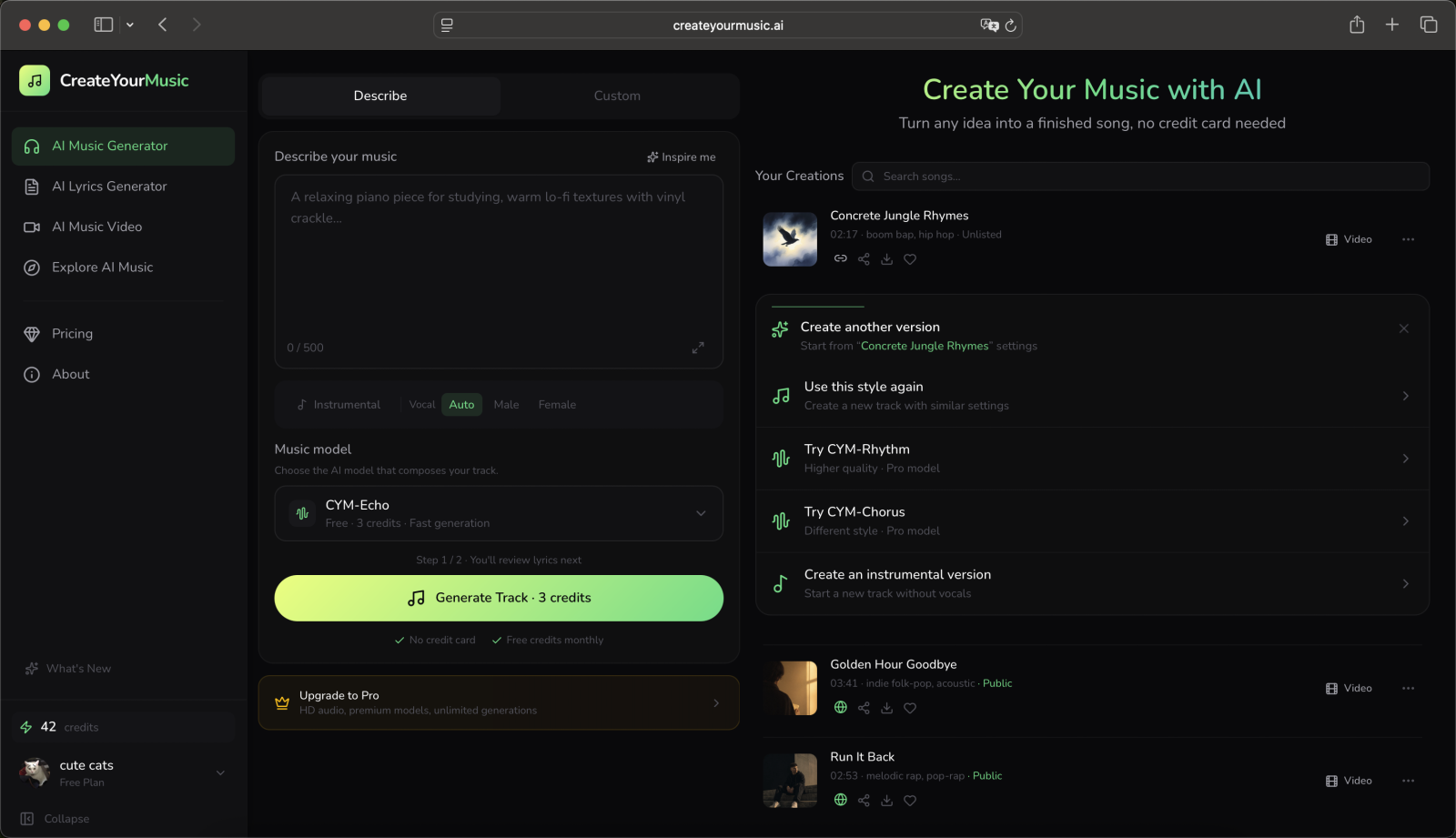
Want AI music with a license you can actually read?
Start free with no card and hear what the generator does with your prompt. Then pick an annual plan with the commercial license and the music video included, or buy a $99 Pay Once pack and hold rights that never expire, with the full Music License Agreement published before you pay a cent.
Make a song free